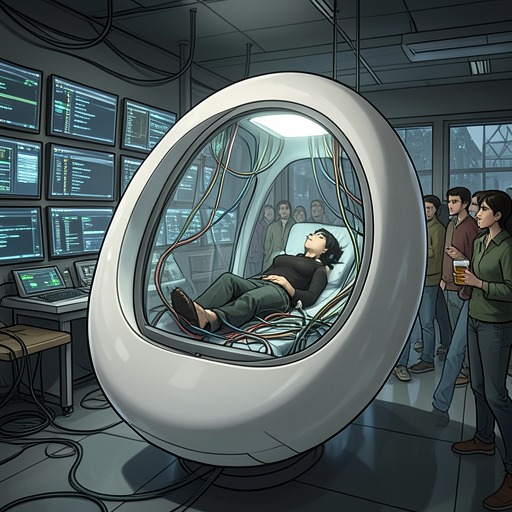
V-Life Mandatory Rest Regulation
The Stars Have EyesV-Life Mandatory Rest Regulation is the platform’s compulsory safeguard against the physical and mental complications of extended virtual-reality immersion. Under the rule, users must leave V-Life for eight hours during every forty-eight-hour period of real-world time. Its decisive significance lies in the contrast it creates: a society that treats virtual activity as ordinary daily life still has to acknowledge that the human body cannot remain inside that life indefinitely.
Definition and Operation
The regulation establishes a repeating cycle of forty-eight hours of permitted use followed by an eight-hour mandatory break. The requirement is presented as a service mandate rather than a voluntary recommendation, indicating that V-Life imposes the interruption as part of its operating conditions. The rule recognizes a practical limit on the human mind: after enough time in virtual reality, users begin to suffer negative side effects and complications.
The wording of the regulation also exposes the unusual status of V-Life in the surrounding society. Virtual reality is not merely an occasional entertainment medium. Joe Mulligan can spend what feels like eight uninterrupted days training inside a competitive game, while the elapsed real-world period is short enough for the platform’s rest cycle to remain the relevant measure. The regulation therefore functions as a boundary between subjective time and bodily time: immersion may stretch experience, but it does not abolish the limits of the user who is immersed.
Effect on Joe Mulligan’s Training
The rule directly interrupts Joe Mulligan and his four friends as they prepare for a tournament in Underwater Yoga Blaster. The game is a genre-defining team-based space-combat arena, and the group has spent several days intensively practicing virtual dogfighting. Although they are enthusiastic hobbyists rather than likely champions, they hope to secure one of the tournament’s lesser prizes, giving their training a concrete competitive purpose.
Their preparation has to stop when most of the group reaches its limit. Joe emerges from what feels like an eight-day training marathon exhausted but strangely satisfied, an experience compared to the feeling of having completed a hard day of honest work. The mandatory break promises him sound sleep in his pod, but the respite is immediately complicated when he notices Maggie hovering cross-legged about a meter above the floor and holding an indistinct brown lump. The regulation thus appears at the threshold between strenuous virtual play and the next unsettling development in Joe’s life: it forces him out of immersion, but does not restore him to an ordinary reality.
V-Life and a Life of Distraction
The rule also helps define why Joe and others spend so much of their lives inside V-Life. Joe explains that, without Maggie, the platform would leave him as another faceless person in the crowd, and that he remains there because he has literally nothing better to do. V-Life gives him a way to stay occupied and interact with people in a society where he sees few meaningful alternatives; without it, he imagines that he might begin performing strange rituals simply to add variety to an otherwise empty existence.
That dependence gives the rest mandate an ironic force. V-Life is both the structure that fills Joe’s time and the institution that periodically removes him from it. The interruption is protective in medical terms, yet it also reveals how completely the platform has become a social environment. The eight-hour absence is not just recovery from entertainment. It is a compulsory return from the setting in which Joe finds companionship, purpose, and relief from the judgment attached to his limited academic and occupational prospects.
Personal Autonomy and Interruption
Joe’s view of the regulation sits within a larger conflict over whether a protected, comfortable life is enough. He describes himself as having graduated with terrible aptitude-test scores and an “Unemployable” mark on his record, despite trying hard. He does not regard his lack of strength, speed, intelligence, or social importance as a tragedy; instead, he values a life free of worry and stress, with virtual reality supplying an easy way to have fun and interact with others.
Against that acceptance, Sarah Johanson and Barry Mulligan both urge him toward greater independence. Sarah treats disciplined effort and military training as routes through which people can improve themselves, while Joe insists that not everyone is born to do something important and that his modest existence is still a good bargain. Barry later tells him to become his own man rather than allowing other people to guide him, warning that Maggie must not become his entire world. The rest mandate belongs to this same tension between care and control: it protects Joe from the consequences of limitless immersion, but its enforced interruption also makes clear that his time and habits are organized by a system outside his individual choice.
Consequences for Joe and Maggie
The regulation’s interruption does not produce genuine emotional rest for Joe. After Maggie’s separation and altered state, he can no longer find comfort in the artificial version of her that responds with monotonous one-word replies. He misses the real Maggie’s smile and speech, and the performance intended to preserve normality instead becomes evidence of her absence. His friends and family help him endure the loss, but he remains responsible for looking after Maggie’s vessel as he promised.
Eventually, Joe decides that passively maintaining the vessel is not enough and tries to take control of his life. He has already attempted his plan twice and failed, yet prepares for a third effort with time, money, and determination. After breakfast, he orders the silent Maggie to come with him. The plan is not another sanctioned period of virtual distraction but an active attempt to reverse the separation: Joe revives the Cult of the Gazing Star and reconstructs the ritual that originally summoned Magh’rathlak the Observer into reality.
The ritual requires a once-a-year planetary alignment, exact chants, props, and devices, information Joe obtains from notes, recordings, and comments left by the entity and transferred from Maggie’s vessel to digital media. Forty-two robed figures gather around an altar while repeating the prescribed chant. Joe recruits even desperate, mentally disturbed, easily manipulated, and dangerously stupid people to fill the ceremony, recognizing that his conduct is exploitative but accepting it if it might bring Maggie back. In this final contrast, the V-Life Mandatory Rest Regulation marks the limit imposed by a technological service, while Joe’s ritual represents a decision to exceed the passive routines that had previously governed him, regardless of the moral and supernatural cost.